.png)
11.2024: Jurisdictional Accuracy for Update Program Locations Unlocked
Released: November 2024
GovDocs rolled out an industry-first technology that further delivers on our promise of worry-free compliance to our customers. With rooftop precision identification, this technology simplifies jurisdictional assignments amid the growing complexity of city and county labor law postings.
Enhancing Our Foundation on Jurisdictional Accuracy
For years the labor law poster compliance has leaned on zip codes and city names for identifying a jurisdiction. Here at GovDocs we know that method does not always portray the correct jurisdiction. It’s clear that jurisdictional precision with longitude and latitude is paramount now and into the future as the trend of local laws continues to increase. Since everything starts with the location in labor law compliance, we knew there needed to be a better way.
GovDocs is releasing an industry-first technology that pinpoints rooftop precision with latitude and longitude coordinates at a time when the rise in city and county labor law postings has made jurisdiction assignments increasingly complex.
In the past 12 months, we recorded 710 poster updates. Notably, 2024 alone has seen a 31.5% increase in new or updated mandatory postings, with 457 city and county jurisdictions affected—a number that continues to rise steadily.
With GovDocs LocationCheck, we've unlocking a smarter way to look at locations and decision-making around employment law compliance. The example pictured in the next section of this page highlights the power of this precision.
If you subscribe to our Minimum Wage and Paid Leave product, you’re familiar with this technology’s power of accurately assigning location's jurisdictions, but now all GovDocs' customers will soon realize the full benefits as part of your Postings subscription.
As part of the LocationCheck launch, we've created this playbook with step-by-step guidance to ensure compliance across all your locations:
- What this means for you
- Finding the Subscription Audit Report
- FAQs
What Jurisdiction Are These Locations In?!
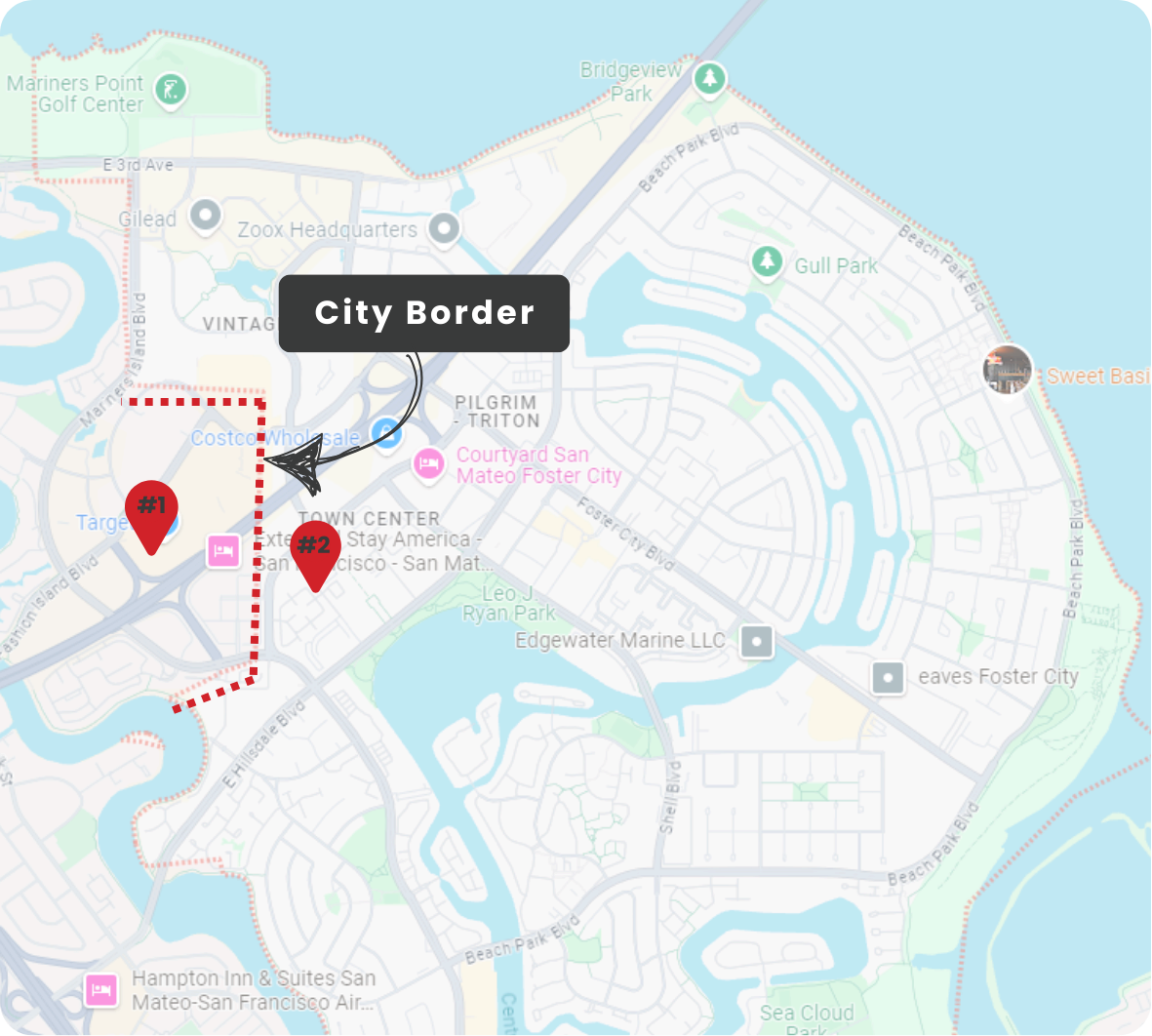
You have two locations with the same zip code and the same city name, oh no! Zip codes and city names were initially made to make mail delivery easier. They weren't created to correspond to jurisdictional boundaries for cities, counties, or states.
|
Location #1 Mailing Address: 12345 E Hillsdale Blvd Foster City, CA 94404 City Jurisdiction: San Mateo |
Location #2 Mailing Address: 12345 2222 Bridgepointe Foster City, CA 94404 City Jurisdiction: Foster City |
Although, both addresses appear they would be in Foster City for their requirement city posters, once verification of LocationCheck is complete, the below list of posters highlights the two different jurisdictional requirements.
|
Location #1 Poster Requirements San Mateo CA City Minimum Wage English Poster San Mateo CA City Minimum Wage Spanish Poster California State on One English Poster California No Smoking Poster U. S. Federal on One English Poster California Mercantile Industry Wage Order |
Location #2 Poster Requirements Foster City CA Minimum Wage English Poster Foster City CA Minimum Wage Spanish Poster California State on One English Poster California No Smoking Poster U. S. Federal on One English Poster. California Mercantile Industry Wage Order |
Easily Verify Poster Compliance at a Location-Level
Gain visibility into your jurisdictional requirements with our new Subscription Audit Report. Employers can streamline auditing by quickly accessing a listing of all location-specific posters included in their GovDocs subscription.
A report at your fingertips to verify subscription posters for each location, to ease communication with location managers and create consistent auditing needs including: location name, posters included in GovDocs' subscription, assigned jurisdiction, + more!
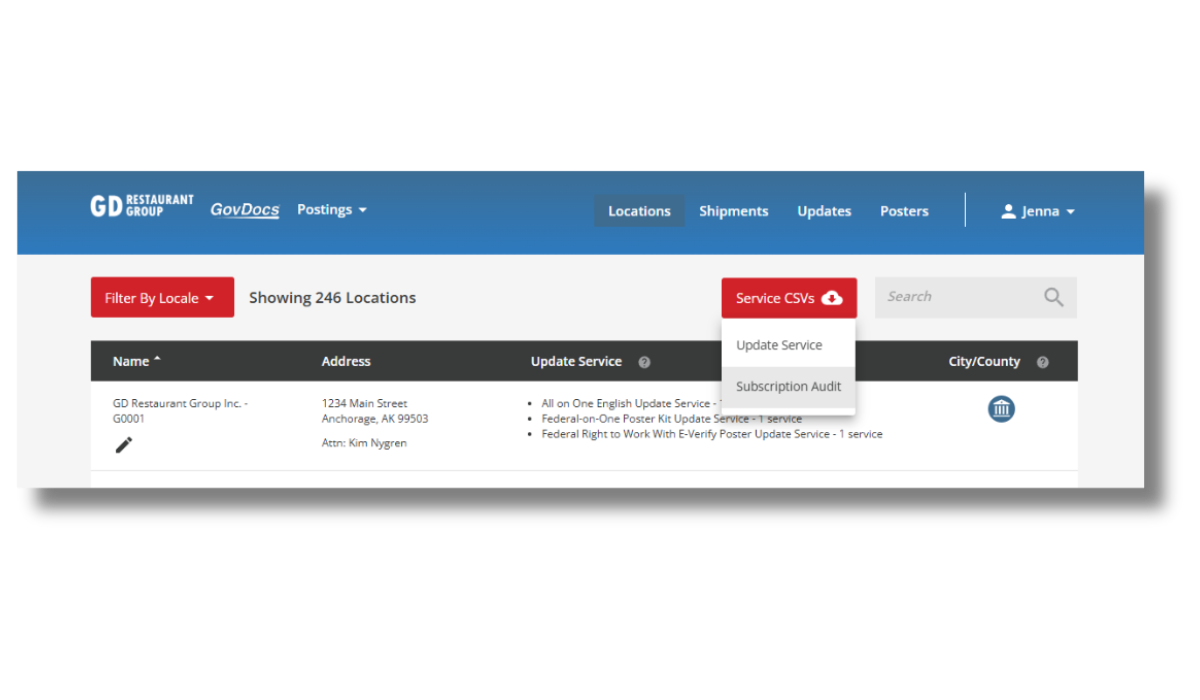
Follow these easy steps to begin your audit.
1.
Login to your GovDocs Postings Dashboard & go to the Locations tab.
2.
Navigate to the Service CSVs Button and click on "Subscription Audit Report" in the drop down to download the CSV report.
3.
Open the downloaded CSV file and begin your location audit.
Frequently Asked Questions
Why is LocationCheck important?
LocationCheck ensures accurate jurisdictional assignments amid the growing complexity of state, city, and county labor law posters. Out are the days of posters being assigned based on zip codes or cities, and in are the days of precision based on technology-backed latitude and longitude coordinates to empower compliance in all locations at a scalable level.
Who else in the industry uses this technology?
As a GovDocs Customers, you are the experiencing a first-of-its-kind technology in the employment law compliance industry. Across GovDocs three solutions of Labor Law Posters, Minimum Wage, and Paid Leave, you are experiencing the most accurate jurisdictional boundaries with this new technology in the industry. Furthering on our promise to you, we are evolving technology ahead of the curve to create worry-free compliance.
Why can't I use zip codes?
There are 4 main reasons zip codes are problematic to determine jurisdictions which include:
• They are designed for the efficient delivery of mail by the U.S. Postal Service and do not necessarily correspond to legal or administrative boundaries such as city limits, county lines, or state borders.
• In some cases, multiple ZIP codes can overlap within the same jurisdiction, or a single ZIP code can be divided among several different municipalities or counties. This overlap can lead to confusion and inaccuracies when trying to determine jurisdictional boundaries.
• ZIP codes do not offer the precision needed for legal or regulatory purposes. Jurisdictions are defined by specific geographical boundaries that require more detailed data, geographic coordinates, to determine accurately.
• Jurisdictions such as city boundaries or county lines can change over time due to annexations, redistricting, or other factors, but ZIP codes may not be updated to reflect these changes. This can result in outdated or incorrect jurisdictional information if relying solely on ZIP codes.
How GovDocs LocationCheck Keeps You Covered
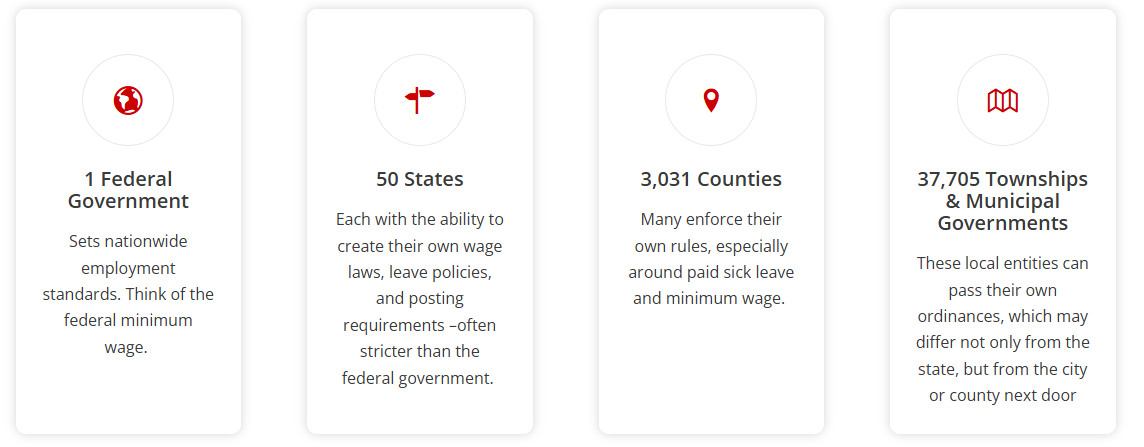
Employment law compliance goes far beyond state and federal rules. With 38,787 jurisdictions nationwide, managing local laws requires more than spreadsheets or guesswork. GovDocs LocationCheck gives HR and compliance teams the confidence that every location is tied to the right jurisdiction—bringing clarity to a complex map of obligations.
The Complexity Problem: 38,787 Ways to Get It Wrong
Employment law compliance isn’t a one-size-fits all, in fact, it’s more like a never-ending puzzle where the pieces change depending on where your employees work and you have physical locations. As of July 2025, GovDocs monitors 38,787 different governing bodies, each with the authority to create rules that impact your workforce.
The real kicker, most HR and compliance teams don’t have visibility, time, or resources into which jurisdiction a location actually falls under – especially when the boundaries get murky.
🚨5 Reasons Organizations Get Local Employment Laws Wrong Without Using GovDocs
Relying on Zip Codes to Determine Requirements:
Your location says one zip code… but three different wage rates apply depending on the actual jurisdiction.
Why it fails:
Zip codes were designed by the U.S. Postal Service for delivering mail—not for legal or compliance boundaries. Yet, many HR systems and third-party vendors still use zip codes to apply employment law requirements. This approach is dangerously imprecise. 42% of enterprise locations pay their employees based on the zip code they are working in.
Trusting City Names at Face Value
Cities often share names with other jurisdictions or are location within counties with different rules.
Why it fails:
City names may seem straightforward—but in the world of employment law compliance, they can be deceptively complex. HR teams and payroll systems often reference “city” as a basic location field… but legal jurisdiction doesn’t always match the name on the mailing address.
Missing Local Laws Completely
Federal and state laws get most of the attention, but cities and counties often have their own requirements – especially around minimum wage and paid leave
Why it fails:
Most compliance strategies start at the federal and state levels—which makes sense. Those laws are widely publicized and relatively easier to monitor. But stopping there is a critical oversight. Many of the most aggressive and fast-changing employment laws are passed at the city and county level, especially around minimum wage, paid leave, and fair scheduling.
In fact, local laws often go further than state mandates, and some exist only at the local level. Without pinpointing the right jurisdiction, you may never even see these laws—let alone apply them correctly.
Operating with Inconsistent Location Data Across Teams
Operations, HR, and payroll may each refer to a location differently. If addresses aren’t standardized and mapped properly, the wrong jurisdiction can be assigned in different departments.
Why it matters:
In large organizations, it’s common for different departments—HR, payroll, operations, legal, and even IT—to refer to the same location in slightly different ways. While that may seem harmless, small inconsistencies in how addresses are entered, stored, or referenced can lead to entirely different jurisdictional assignments. Jurisdiction-based compliance is only as accurate as the location data feeding it. If the source of truth isn’t consistent, the laws you apply may not be either.
Using a Vendor that Isn’t Accurate in their Assignments
Not all vendors track down to the municipal or township level – or update frequently enough to keep up with local changes. That means you’re trusting incomplete data.
Why it fails:
Many HR teams rely on third-party vendors or internal tools to determine which employment laws apply at each location. But not all vendors are created equal. Some don’t track all jurisdiction levels or use overly simplistic methods—like city name or zip code—to assign laws.